A few months ago, someone in a Facebook group I follow asked a simple question: “Why would anyone buy my ebook when they can just ask ChatGPT the same thing for free?” Nobody had a clean answer. A few people got defensive. A few agreed and said they were quitting. Most just went quiet.
That silence is the real story here.
Tools that used to take real time and skill, writing assistants, image generators, slide deck builders, website makers, automation apps, have gotten good enough that a decent-looking digital product can be built in an afternoon. Ebooks, templates, mini courses, planners, stock graphics, none of it requires the effort it used to. And that has left a lot of digital product sellers wondering if the whole business model is quietly falling apart underneath them.
So is AI actually destroying the digital products business? Or is it just changing who wins and who doesn’t?
What Has Actually Changed Because of AI
Walk through any digital product category and you’ll see the same pattern repeating.
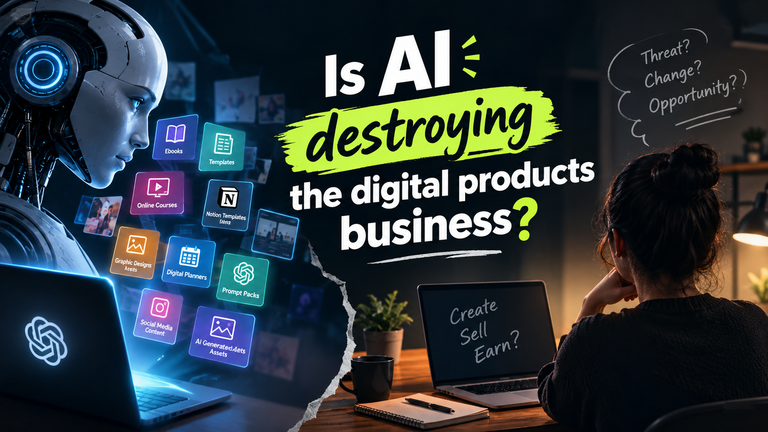
Ebooks that once took weeks of research and writing can now be drafted in hours. Online course outlines, scripts, and even slide visuals can be generated with a few prompts. Notion templates, once a genuine display of someone’s organizational thinking, are now something you can ask an AI to build from scratch in minutes. Prompt packs, which barely existed as a category three years ago, exploded and then got saturated almost as fast because, ironically, AI can generate more prompts just as easily as it generated the ones being sold.
Digital planners, printable trackers, social media caption packs, canva templates, AI-generated art bundles, the entire “low effort, high volume” side of the digital products world has been hit the hardest. Not because these products stopped being useful, but because the barrier to creating something similar dropped to almost nothing.
If your product’s main value used to be “I did the work so you don’t have to,” AI has quietly removed a lot of that advantage. The work itself got cheap.
Why Some Digital Products Are Losing Value
Here’s the uncomfortable part. A lot of what sold well in the digital products space for years was really just packaged information. A PDF explaining how to meal prep. A template listing common Instagram caption formulas. A guide walking through basic productivity tips. None of this required deep expertise, it required someone willing to compile it and package it nicely.
That kind of product is struggling now, and for a simple reason: information itself has become cheap. When a customer can get a comparable answer for free or near-free from an AI tool in ten seconds, paying $27 for a PDF that says roughly the same thing stops making sense to them.
At the same time, marketplaces like Etsy, Gumroad, and course platforms have been flooded with AI-generated products that all look and sound the same. Search for “budget planner” or “social media content calendar” and you’ll find hundreds of nearly identical listings, many clearly built the same way, with an AI outline, a template, and a quick Canva pass. Customers have started noticing. Trust has taken a hit across the board, even for creators who didn’t cut corners, because the flood of low-quality copies makes everything harder to evaluate.
Standing out has genuinely gotten harder. Not impossible, but harder.
Is AI Actually Destroying the Business?
Here’s where I’d push back on the doom narrative, though.
AI isn’t destroying the digital products business. It’s destroying a specific kind of digital product: the generic, low-effort, easily-replicable kind. That’s an important distinction, and it changes how you should think about your own strategy.
There’s a real difference between selling information and selling transformation. Information is “here are ten tips for better sleep.” Transformation is a step-by-step system built from someone’s actual experience helping people fix their sleep, complete with troubleshooting for the specific ways people get stuck. AI can approximate the first one convincingly. It really struggles to replicate the second, because transformation requires judgment, specificity, and often a track record that a generic model output simply doesn’t carry.
The products getting wrecked right now were always vulnerable. They were commodities pretending to be premium goods. AI didn’t create that weakness, it just exposed it faster than the market would have otherwise.
What Digital Products Can Still Win in the AI Era
So what actually holds up?
Niche-specific products do well because they solve a problem for a narrow, well-understood audience rather than a general one. A financial planning template for freelance photographers will always beat a generic budgeting spreadsheet, because it already accounts for irregular income and gear expenses.
Original frameworks hold value because they represent a way of thinking, not just a collection of facts. If you’ve developed your own method for something, that’s genuinely hard to replicate, since it comes from your specific experience.
Practical tools that save real time, like a calculator, a swipe file organized around a specific workflow, or a script generator built for a particular industry, keep their appeal because the value is in the function, not just the content.
Templates that solve one very specific problem beat generic ones every time. A contract template for wedding photographers dealing with rescheduling clauses is worth more than a generic freelance contract template, even though both are “just templates.”
Community-driven products, where the purchase includes access to a group, feedback, or ongoing support, are harder to copy because the value isn’t static content, it’s an evolving relationship.
Products built on personal expertise and case studies work because customers are paying for someone’s actual results and the reasoning behind them, not just a summary of general knowledge.
The pattern across all of these: they’re hard to fake convincingly, and they require something an AI model can’t fabricate on its own, which is direct, tested, personal experience.
The New Advantage: Human Plus AI
None of this means creators should avoid AI. That would be a bit like avoiding spreadsheets because calculators exist. The smarter move is treating AI as part of the production process rather than as the competition.
A realistic modern workflow looks something like this: you start with an idea based on a problem you’ve actually seen people struggle with. You research it properly, talking to real customers if you can. You use AI to speed up drafting, generate variations, or handle repetitive formatting work. Then you bring in your own expertise to correct, refine, and add the specific details that only someone who has actually done the thing would know. You edit for voice and accuracy. You test it with real users before a full launch. You collect feedback and improve the product based on what actually confused or helped people.
AI handles speed. You handle judgment, taste, and trust. Customers can tell the difference between a product that was generated and one that was genuinely built, even when they can’t articulate exactly why.
AI Is Changing the Definition of a Digital Product
It’s also worth stepping back and noticing that the category itself is shifting. A “digital product” used to mean a static file, a PDF, a video, a spreadsheet. That definition is loosening.
We’re starting to see AI-powered templates that adjust based on user input, interactive resources that respond rather than just inform, and personalized products that adapt to the buyer instead of offering one fixed version to everyone. Courses are increasingly bundling in AI-assisted feedback or coaching layers. Some creators are blending digital products with light services, like a template paired with a short review call, essentially productizing their own expertise instead of just their content.
This is less an ending for digital products and more a widening of what counts as one.
What This Means for New Creators
If you’re starting out now, here’s the honest version of what to focus on.
- Choose a specific audience instead of a broad one.
- Find a problem that actually causes people pain, not just mild inconvenience.
- Build the product around solving that one problem well.
- Use AI to handle drafting, formatting, and repetitive production work.
- Add your own experience, original examples, and judgment so the product can’t be recreated by a prompt alone.
- Test it with real people before you scale it.
- Actually use the feedback to improve it, rather than just collecting it.
- Build trust over time through consistent content and an honest personal brand.
None of this is complicated, but it does require more effort than the “compile some tips and sell a PDF” approach that used to work reasonably well. That’s the trade-off. The bar moved up.
The Future of Digital Products
It’s reasonable to expect that generic, low-effort products will keep losing ground, and that marketplaces will keep getting noisier before platforms find better ways to surface quality. It’s also reasonable to expect that products built around genuine expertise, specific niches, and real outcomes will hold or grow their value, since AI struggles to replicate lived experience convincingly.
What’s speculation, and should be treated as such, is exactly how fast this shift happens, which platforms adapt well versus poorly, and whether new categories of AI-native digital products become dominant or stay niche. Anyone claiming certainty about those specifics is guessing, same as the rest of us.
Conclusion
AI is not destroying the digital products business. It’s destroying the version of it that relied on information being scarce. For years, a lot of digital products succeeded simply because putting together a decent PDF or template took more effort than most people were willing to spend. That advantage is gone, and it’s not coming back.
What’s left is a business that rewards originality, specific expertise, and real trust between creator and customer, the same things that were always the actual foundation of a good product, just harder to hide the absence of now.
The creators who adapt, who use AI to move faster while doubling down on what only they can offer, aren’t going to struggle in this shift. The ones who don’t adjust were probably going to struggle eventually anyway, AI just moved up the timeline.
FAQs
1. Is AI really destroying the digital products business? No. AI is mainly reducing the value of generic, low-effort digital products. Products built on real expertise, specific niches, and genuine outcomes are still performing well.
2. What types of digital products are losing value the fastest? Generic ebooks, broad templates, basic prompt packs, and other easily-replicable content that AI tools can approximate quickly.
3. Should I stop selling digital products because of AI? Not necessarily. It’s more useful to reassess what makes your specific product hard to replicate, rather than exiting the space entirely.
4. Can AI-generated digital products still sell well? Yes, if they’re built for a specific audience, solve a real problem, and include human judgment and refinement rather than being unedited AI output.
5. How can I make my digital product stand out in a saturated market? Focus on a narrow niche, add original frameworks or case studies from your own experience, and be transparent about the value you personally bring.
6. Is it okay to use AI tools while creating digital products? Yes. Using AI for drafting, research, or formatting is generally fine as long as you add real expertise, testing, and originality on top of it.
7. What will digital products look like in the next few years? Likely a mix of traditional formats and newer interactive, personalized, or AI-assisted formats, though the exact pace and shape of that shift is still uncertain.
8. What’s the biggest mistake new digital product creators make right now? Building generic, low-effort products aimed at broad audiences instead of solving a specific, painful problem for a well-defined group of people.
Suggested featured image concept: A split-style visual showing a stack of generic, identical-looking template thumbnails fading out on one side, contrasted with a single, distinct, well-crafted digital product mockup (like a niche planner or framework diagram) highlighted on the other side, symbolizing the shift from generic to original.
Internal link topic suggestions:
- How to find a profitable niche for your digital product business
- Etsy digital product SEO: getting found in a crowded marketplace
- How to use AI tools without losing your personal brand voice
- Building a digital product around your own case studies and experience
- Pricing strategy for niche vs. generic digital products